
REFLECTION
How to assess “good usability”?
October 28, 2020
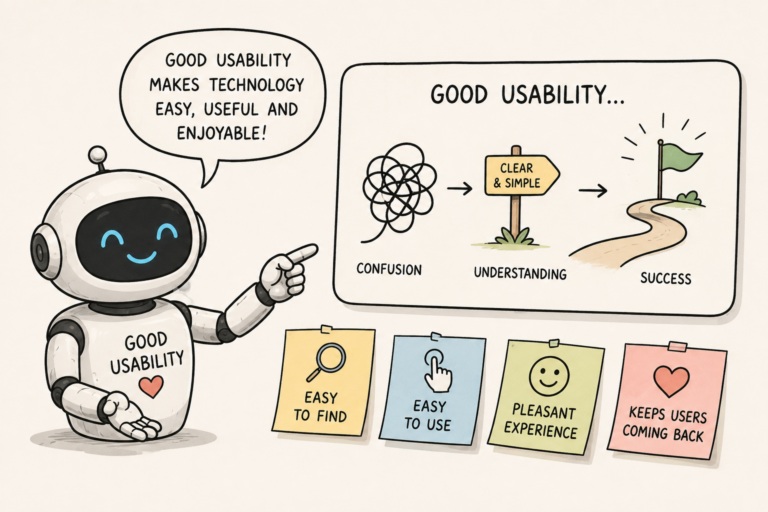
Arthur C. Clark, a British science fiction writer, famously said that “any sufficiently advanced technology is indistinguishable from magic”. As HCI researchers, we reserve the right to call ourselves magicians in the correct context. What makes an application good is tantamount to asking “what is magic?”. However, unlike magicians, we reveal our trade secrets quite openly so let’s dive into the ingredients of magic (and dark arts).
A brief history of “what’s good?”
Millions of artists and designers over the history of human-kind have tried to establish a definition of good design. The first recorded instance of this endeavor comes in the form of three design principles, given by Vitruvius in the first century BC (Zhang & Galletta, 2015):
- Firmitas: Firmness, strength, and durability of the design.
- Utilitas: The usefulness and applicability of the design.
- Venustas: The aesthetic appeal of the design.
The designs which complied with the above principles were adjudged to be good. The most famous use of these design principles is Leonardo Da Vinci’s “Vitruvian Man”. Da Vinci utilized Vitruvius’ design principles to create the ideal human body with perfect proportions. It would not be wrong to call Da Vinci one of the first user experience designers.
Some of the modern definitions of usability are derived from the field of “Human Factors and Ergonomics”. Owing to the advances made in modern psychology with the help of Sigmund Freud and his student Carl Jung, it was possible to adopt a cognitive view of “good applications”.
Usability Engineering
The definition of “good” and “bad” we are interested in comes from the field of “Usability Engineering”. Usability Engineering was conceived in response to the growing needs of designing screen interfaces that were relevant to the needs of the users and did not require a steep learning curve. Computers designed before the 1980s assumed its users to be experts and did not factor the concerns of a lay user in its design. However, with the increasingly falling prices of computers, more and more naive users started buying personal computers for work and recreational use. The prevailing school of thought at that time was “essentialism”, wherein usability was seen as an inherent feature (Cockton, 2004) of an interface with an emphasis on designing “user-friendly” interfaces. Consequently, user interfaces started to be judged on an inscrutable single-dimensional metric of “user-friendliness”.
In the late 1980s and early 1990s, a new school of thought started emerging which envisioned usability as an emergent property of interactivity. This idea was prominently championed by Lucy Suchman (1987), who underscored the importance of mutual intelligibility between humans and machines. Her idea took the form of “situated” actions wherein the human is aware of the context of their inquiries and the state of the machine, and the machine is expected to provide relevant responses (or lack of) based on the human’s actions. Contextual usability gained prominence with the contributions of Don Norman and Jakob Nielsen. Using the contextual definition of usability, they were able to give birth to the field of “usability engineering”.
Modern definitions
Whether a piece of software is good or not depends on the usability of the piece of software at hand. Jakon Nielsen (1993) enlisted the help of five attributes to determine the usability of an interface: (1) learnability, (2) efficiency, (3) memorability, (4) errors (low error-rate and reporting), and (5) satisfaction. Don Norman (2002), in The Design of Everyday Things, tried to define good designs using a psychological perspective. Using human-centered design (HCD), which puts the needs of the user at the center of the design process, he was able to characterize good design as one which “.. requires good communication, especially from machine to person, indicating what actions are possible, what is happening, and what is about to happen”. Norman catapulted words like affordances, signifiers, constraints, mappings, and feedback into the vocabulary of every interface designer. However, the most important concept Norman introduced was “conceptual models”. He argued that in order for a design to be good it needs to match the conceptual model (or mental models) of the user. A conceptual model is an explanation for how things form meanings in a user’s mind. It does not have to be accurate but it needs to be an approximation of a user’s system image. An interface can be ascertained to be good if the conceptual model of a designer and a user could be bridged.
Another bridge a designer is required to help the user cross is the “gulf of execution” and “gulf of evaluation”. “Gulf of execution” reflects what a user could do with the system and “gulf of evaluation” reflects how a user could evaluate the actions of the system. If both of these processes require a user to exert minimum cognitive effort then the piece of software is “good”.
That’s all good but how do we measure “goodness”?
One of the goals of Human-Computer Interaction (HCI) research is to put people first in all endeavors. It’s the reason why the name HCI is preferred over Computer-Human Interaction(CHI) (putting the human first — at least symbolically). As a result of this human-first approach, the usability of the system becomes paramount in assessing whether a system is good or bad.
Unfortunately for HCI researchers, there is no craftily constructed magic box that accepts the system as input and produces a usability score as an output. Since “usability” is an abstract concept, it cannot be measured in its whole, instead, its parameters are measured. By measuring a system’s learnability, efficiency, memorability, errors, and satisfaction one can attempt to measure the usability of a system. Various methods and approaches have been employed to capture a system’s parameters. These methods can be classified into two types: analytical and empirical.

Good ideas start with a conversation.
Interested in collaborating, exchanging ideas, or exploring new research? Let’s connect.
-
Research -
Collaboration -
Mentorship -
Conversation