Reflections
Selected writings on Conversational AI, HCI/HCAI Research, and Academia
Read Reflection
FEATURED REFLECTION
How to Write an HCI Introduction: A Six-Part Recipe
August 20, 2026
For me, a good introduction does one thing particularly well: it makes the rest of the paper feel inevitable.By the time I reach the research questions, I should understand why these are the questions being asked. By the time I reach the contributions, I should understand why those contributions matter. And somewhere along the way, I should have stopped wondering what the paper is actually about.
More Reflections
Good Ideas and Where to Find Them?
June 21, 2025
A good idea isn’t just novel—it’s something you care enough about to sit with for a while. This reflection offers a practical, personal framework for generating HCI research ideas that matter. Whether you’re stuck or overflowing with possibilities, this guide helps you generate ideas and trace where the novelty lies.
Read Reflection
Dealing with Uncertainty in Academic Research
April 16, 2025
During an extraordinary voice user interface study, one participant experienced what should have been a frustrating Alexa error. Instead, she chuckled and said, “It’s like a silly child.” That single metaphor – casual yet profound – reframed the interaction entirely. Ot transformed technological failure into something human, something manageable.
Read Reflection
Why to get a PhD? Insights Beyond ChatGPT’s Intelligence
July 17, 2024
On June 19th, 2024, Mira Murati, Chief Technology Officer at OpenAI, claimed that the next generation of ChatGPT would possess “PhD-level intelligence.” This statement quickly became a target of online ridicule and incited sarcastic existential dread among already stressed PhD students. While it’s uncertain whether this will actually happen — and I am sure someone will devise a clever little benchmark to compare ChatGPT with PhD students over some trivial test and call it “A Degree is All you (don’t) Need” — this prediction is not my main concern. What troubles me most is the implication that earning a PhD equates to achieving a certain arbitrary level of intelligence, or a PhD would boost your intelligence to that level.

Read Reflection
The Unexpected Gift of Failing IIT-JEE
July 10, 2024
At 30, I defended my PhD and signed an offer to become an Assistant Professor at an R1 University in Boston. But I was labeled a failure before I had even turned 18. For at least six months, people did not smile when they talked to me. Maybe they thought it was somehow disrespectful. Maybe they were trying to hide the schadenfreude. Perhaps I am misremembering. I will never know. But I know when it happened. I can still slip into that day. It was the morning the 12th-grade Gujarat Board results were released. My parents and I were hunched in front of a 17-inch laptop screen with a speck at the center. With bated breath, my father typed my roll number and pressed enter, and in the same breath, his face dropped. I did not want to look at the marksheet. My mom tried to wipe the screen and checked again. No change. 73%.

Read Reflection
Exploring Realistic Use and Metaphors for Understanding ChatGPT
March 29, 2023
If you work with AI, you are probably inundated with ChatGPT news and takes. ChatGPT’s release has seen it generate a lot of hype, including comparisons with the invention of the steam engine and fire—or even God. However, these comparisons (apart from being sensationalized) are also based on limited unsystematic use and minimal domain knowledge. I am a conversational AI researcher getting a Ph.D. in HCI, and I decided to try using ChatGPT in a realistic work-related context for a month to understand this phenomenon which has made some very serious people convulse with delirium. Here are the ground rules:

Read Reflection
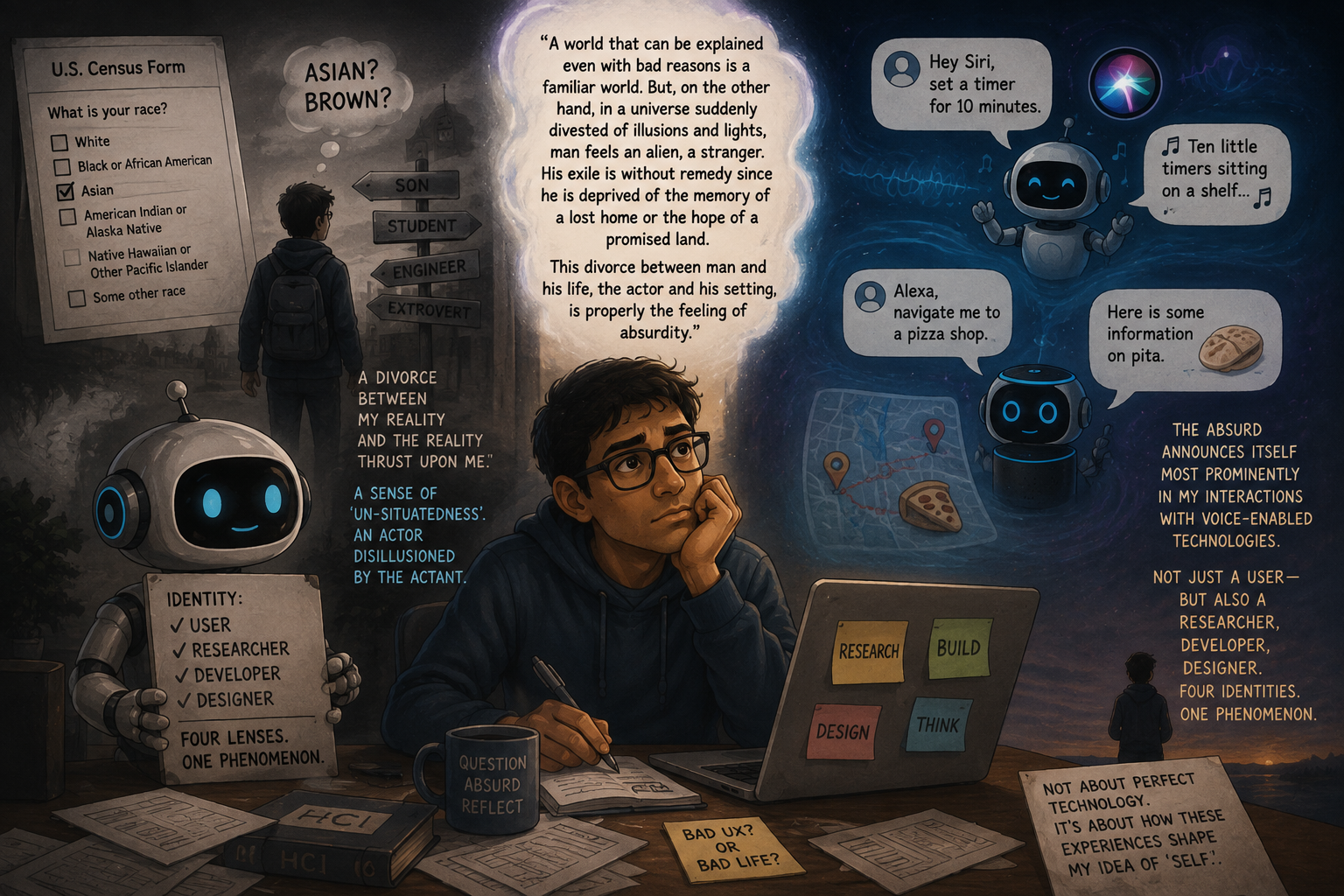
Voice Interfaces and the Absurd
August 20, 2021
I have grappled with the ‘absurd’ since I first got to the US and had to fill a form listing my race. Before that, I had never thought of myself as belonging to a race. My identity was bracketed in many words—son, student, engineer, or extrovert—but never Asian or brown. This divorce between my reality and the reality thrust upon me elicited a lurking sense of ‘un-situatedness.’ An actor disillusioned by the actant. That day something strange happened—I inadvertently acquired a new lens to survey the world. Now my world was divided into races, and differences promptly emerged. Differences I still feel stifled or enraged by.
Read Reflection
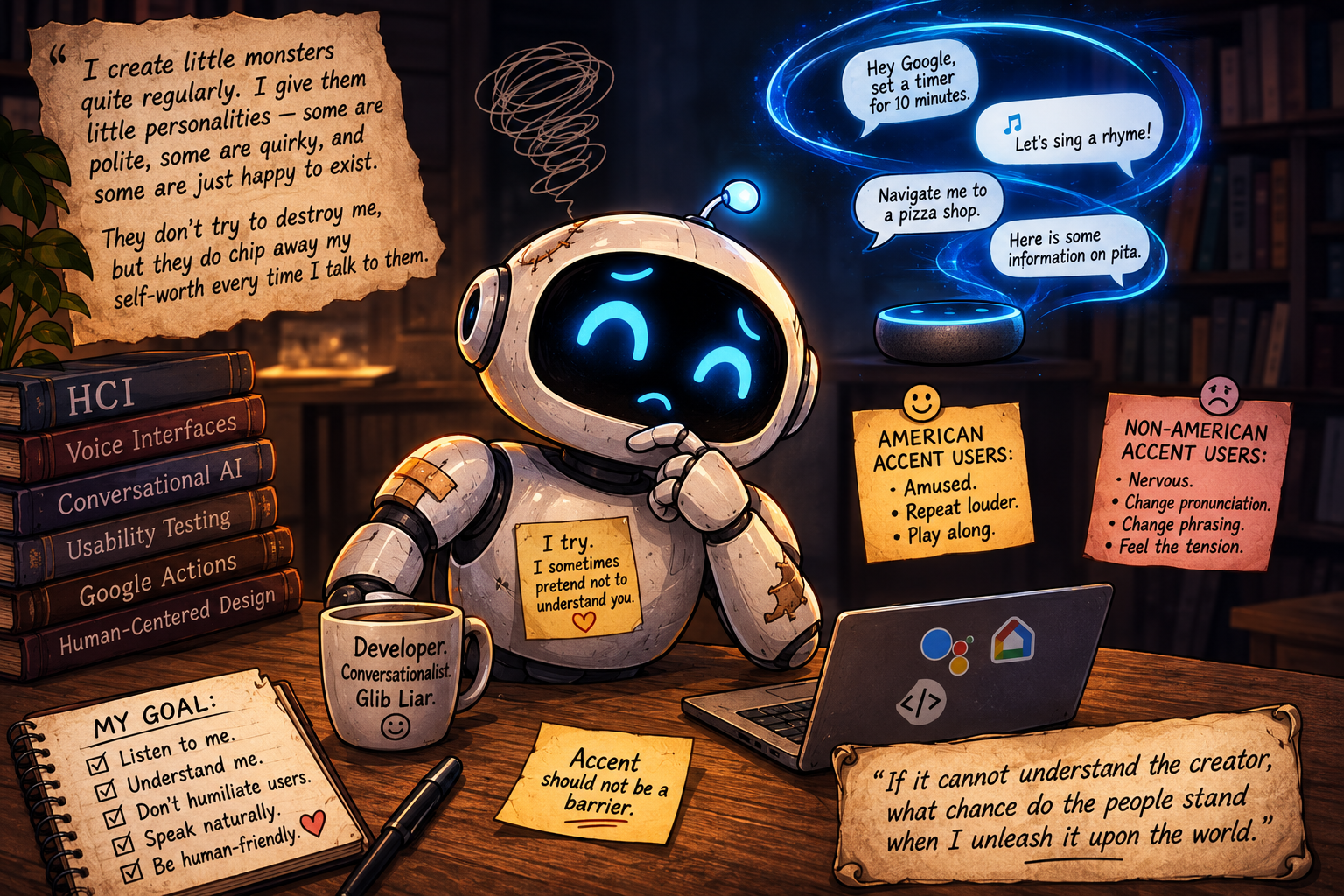
Frankenstein’s AI
March 16, 2021
Victor Frankenstein created a monster so appalling that he sought to destroy it. However, in typical storytelling justice, the monster destroys Victor (and itself). Victor and the monster are in a tryst with each other inadvertently to provide meaning to each other’s lives.
Read Reflection
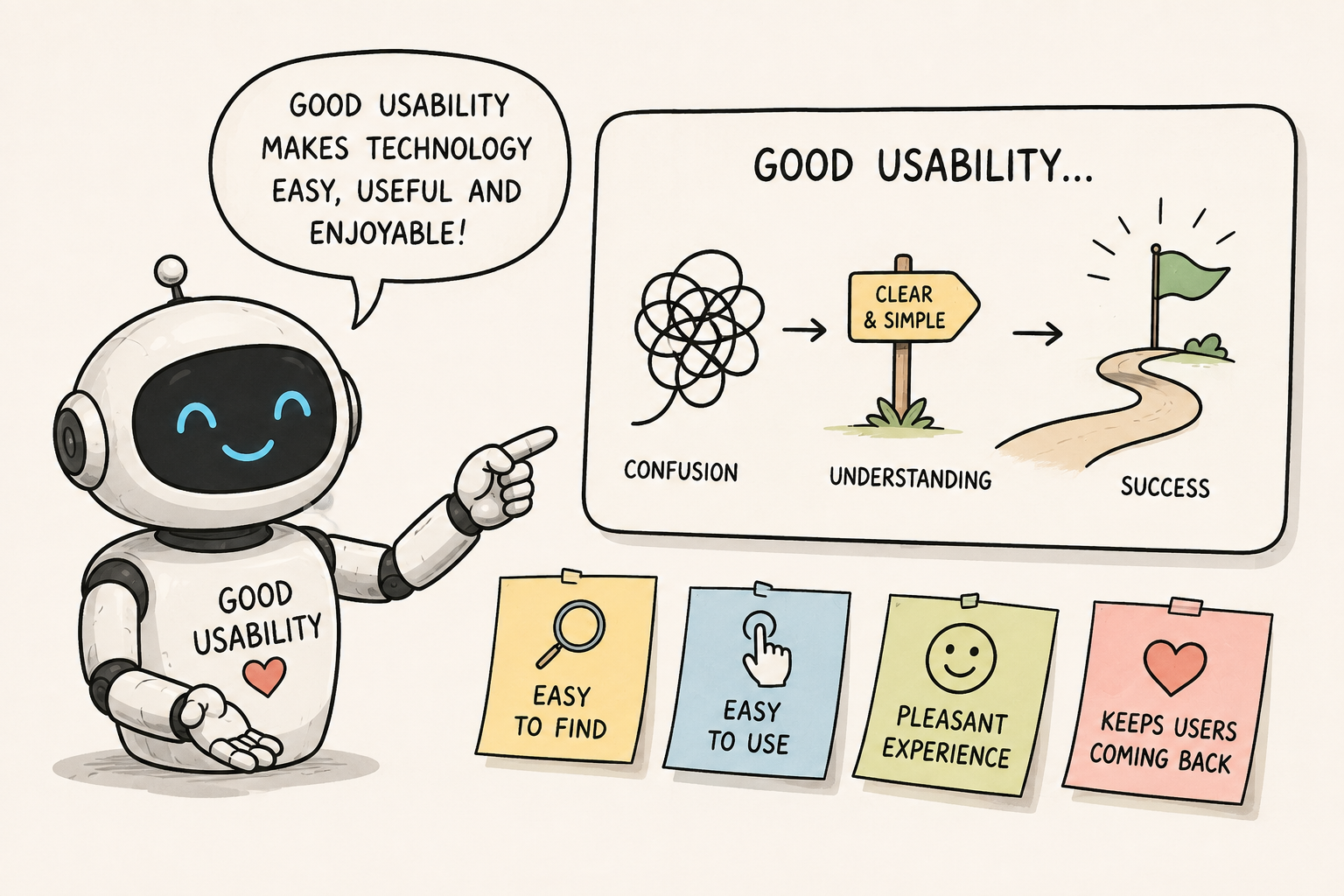
How to assess “good usability”?
October 28, 2020
Arthur C. Clark, a British science fiction writer, famously said that “any sufficiently advanced technology is indistinguishable from magic”. As HCI researchers, we reserve the right to call ourselves magicians in the correct context. What makes an application good is tantamount to asking “what is magic?”. However, unlike magicians, we reveal our trade secrets quite openly so let’s dive into the ingredients of magic (and dark arts).
Read Reflection
Embracing Zero
October 8, 2020
The discovery of zero is often cited as one of the most important achievements in the history of mankind akin to the invention of formalized language. The first instance of the use of zero is dated back to 5000 years ago, in ancient Mesopotamia, where they introduced a numeral system in which zero was used as a placeholder. However, the first recognition of zero as a number is recorded about 1500 years ago in India. When you think about it, zero means nothingness so how can the absence of something be a thing? Well, India’s rich philosophical culture had an answer to this. The concept of “Shunyata” (cleansing one’s mind from thoughts through meditation) was indoctrinated into Indians by Buddhists. This cleansing allowed “Shunyata” to be recognized as a state of its own.